Activated Carbon Filters
Particulate filters remove dust and airborne particles. Activated carbon filters are used when the ventilation system must also reduce gases, odours and volatile organic compounds.
For HVAC contractors, installers, facility managers and engineering teams, this distinction matters. If the issue is dust, particulate filtration is required. If the issue is odour, VOCs or gas-phase contamination, the system needs molecular filtration.
What Activated Carbon Filters Remove
Activated carbon filters are designed to capture substances dissolved in air. They are used for contaminants that pass through ordinary mechanical filtration media, including:
- ozone, O3;
- nitrogen dioxide, NO2;
- sulphur dioxide, SO2;
- carbon monoxide, CO, when suitable media is selected;
- volatile organic compounds, VOCs;
- tobacco smoke, cooking odours, fuel vapours and process-related smells.
These pollutants are common in city-centre buildings, industrial zones, airports, ports, car parks, laboratories, commercial kitchens and exhaust-air systems. A high-efficiency particulate filter may protect the AHU and reduce fine dust, but it will not automatically solve odour or gas-phase contamination.
How Activated Carbon Filtration Works
Activated carbon is a highly porous material with a large internal surface area. Gas molecules are captured mainly by adsorption: they are attracted to and retained on the surface of the carbon.
Performance depends on the contaminant type, activated carbon structure, contact time, air velocity, temperature, humidity and, in some applications, chemical impregnation. This is why two filters with similar dimensions may perform differently in operation.
Where Activated Carbon Filtration Is Used
Urban supply air
Offices, schools, hotels and residential buildings near heavy traffic may require molecular filtration to reduce traffic-related gases and outdoor odours before air enters occupied spaces.
Commercial kitchens
Restaurants, food courts, hotel kitchens and takeaway premises often need odour control in exhaust systems. Carbon filters should normally be installed after suitable grease and pre-filtration.
Industrial and process ventilation
Manufacturing, food production, packaging, coating, solvent handling and technical exhaust systems may require activated carbon to reduce VOCs, vapours or process-related smells.
Laboratories and technical spaces
Laboratories, waste rooms and service areas can generate odours or chemical vapours that require a dedicated molecular filtration stage.
YGLA Activated Carbon Filter Range
YGLA manufactures activated carbon filters in several formats, allowing engineers and service companies to select the right product according to AHU layout, available space, filtration objective and application type.

Compact Activated Carbon Filters
YGLA Compact activated carbon filters are suitable when particulate filtration and molecular filtration must be combined in one practical filter format. They are designed for ventilation systems where existing filter space is limited and the filtration section cannot be significantly modified.

V Type Activated Carbon Filters
YGLA V type activated carbon filters are designed for systems that require a larger filtration area within a compact installation depth. The V-shaped design increases the available media area, making it suitable for higher-capacity AHUs and demanding commercial ventilation systems.
Cylindrical Activated Carbon Filters
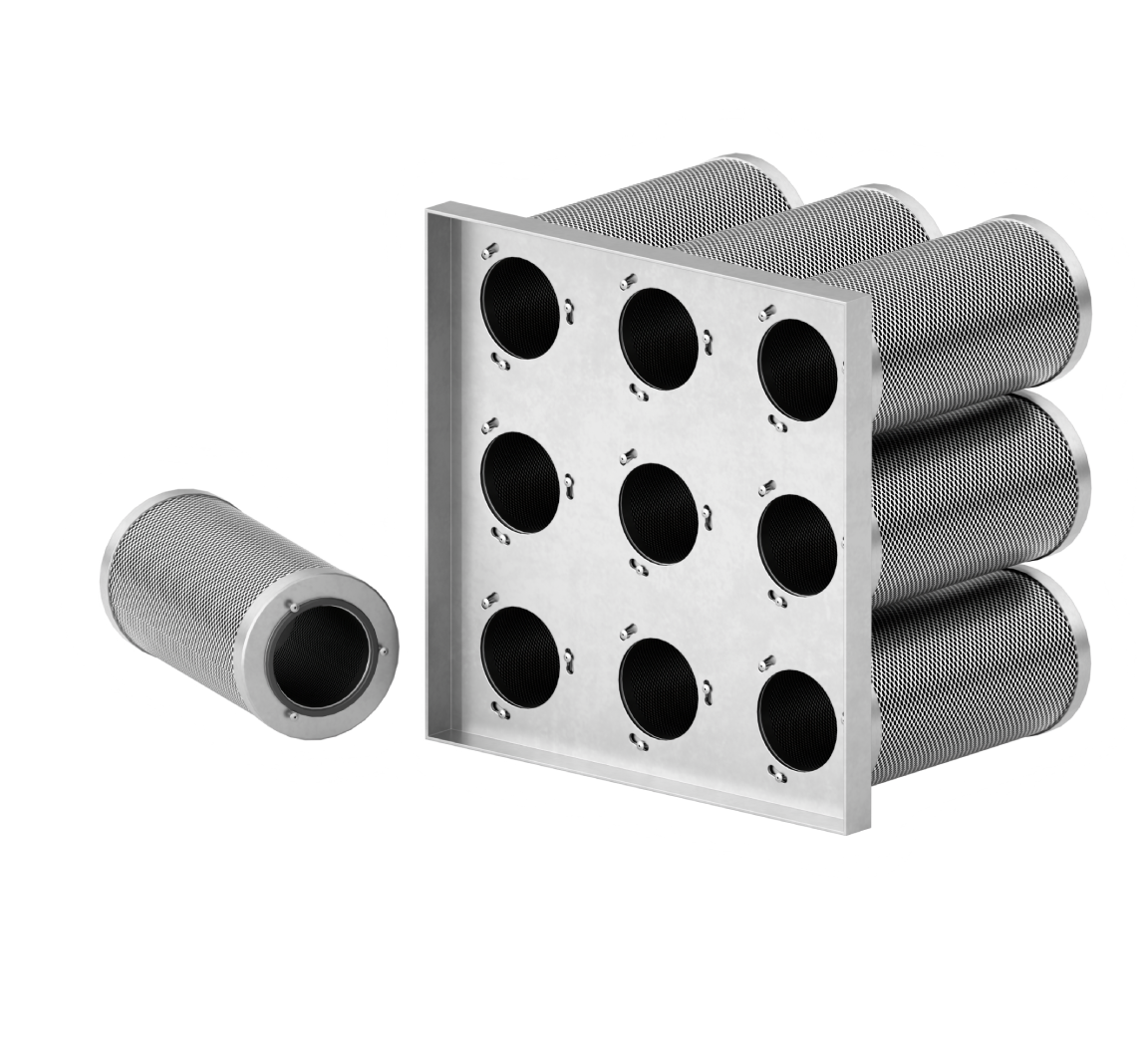
YGLA Cylindrical activated carbon filters are intended for dedicated molecular filtration applications where gas or odour control is the primary function. The cylindrical format is especially suitable for exhaust-air treatment and applications requiring impregnated or not impregnated activated carbon granules.
Why Pressure Drop Is Not Enough
Particulate filters usually load with dust during operation, causing pressure drop to increase. Activated carbon filters behave differently. As the carbon becomes saturated, molecular adsorption capacity decreases, but pressure drop may remain relatively stable.
For this reason, activated carbon filters should not be replaced only by final pressure drop. Replacement should be based on operating time, application requirements, odour breakthrough, or gas concentration measurements before and after the filter.
Selecting the Correct Filter
Correct activated carbon filter selection starts with the application. To support accurate selection, provide the filter type, dimensions, required filter class, quantity, target odour or contaminant, air handling unit type and installation environment.
For replacement projects, drawings, photos or existing product references help YGLA match the filter correctly. For new projects, YGLA can support the selection of Compact, V type or Cylindrical activated carbon filters according to system layout and filtration objective.
Need help selecting the right filter or custom dimensions?
Contact YGLA for technical guidance, certificates, and quotation support.
www.ygla.lt/contacts
sales@ygla.lt
+370 5 2056090

