Energy saving
- Home
- Products
- V Type filters
- Energy saving
| Filter class ISO 16890 | ePM1 60% |
| EN 779:2012 class (previous standard) | F7 |
| Material | Progressive synthetics |
| Frame | High-quality durable plastic |
| Permanent operating temperature | < 70°C |
| Relative humidity | 100% |
| Recommended final pressure drop |
The smaller value must be selected: ePM10 / ePM2.5 / ePM1:
|
| Max. final pressure drop | 450 Pa |
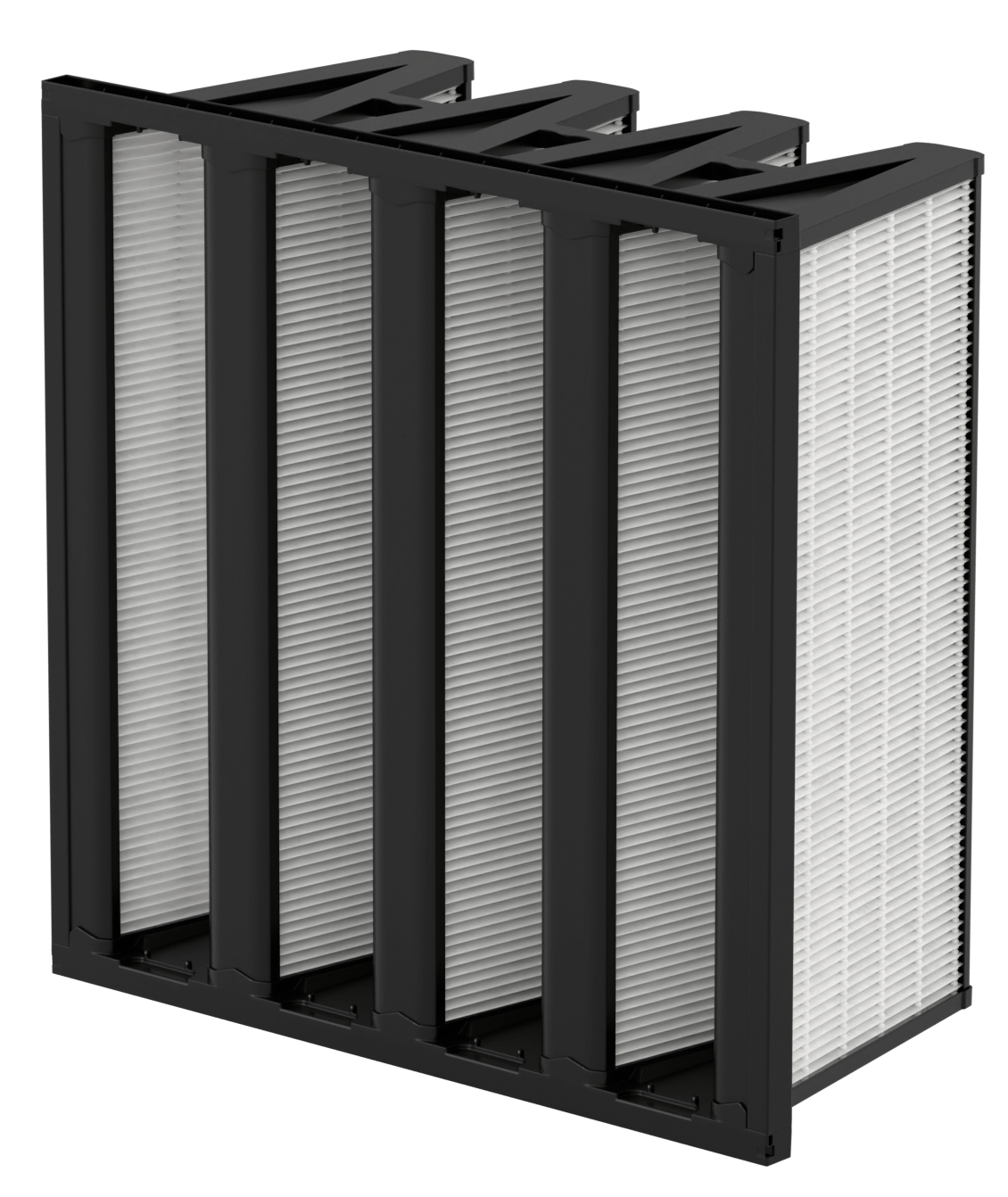


The V-type filter construction has a large amount of filtering material in a small area. The large filtration area allows the filters to be used in high air flow conditions. These filters are commonly used in the air supply section of ventilation units. The large filtration area ensures efficient air cleaning and the maintenance of stable supply air parameters. V-type filters clean the air from various particles, even extremely small ones – such as bacteria, fine dust, and pollen. Due to their large surface area, these filters have a long service life and lower air resistance.
ADVANTAGES:
- Light and sturdy frame
- Convenient and easy filter replacement
- Low pressure drop
- Low energy consumption
FILTERING MEDIA
V-type compact filters use progresive synthetic material that effectively removes various pollutants, dust, pollen, particulate matter, and bacteria from the air. The filters are available in different filtration classes, according to various air quality requirements.
AIR FILTRATION INNOVATIONS
V-type filters, known for their advanced design and efficiency, are creating new possibilities for air filtration. Modern technologies not only enhance their performance but also contribute to sustainability, energy savings, and human health.
ENERGY EFFICIENCY
Modern V-type filters are designed to ensure low air flow resistance, allowing the ventilation system to operate more efficiently. Lower energy consumption and durable materials not only reduce energy costs but also contribute to the sustainability of the ventilation system. This is especially important in commercial spaces, where energy consumption for ventilation is higher.
FILTER MEDIA
More efficient progressive synthetic materials are being developed, ensuring better air purification and longer service life.
IMPROVED DESIGN
The frame is made of durable plastic, ensuring the filter‘s rigidity and shape.
 How to correctly measure V-type filters?
- Place the filter in the same position as shown in the picture.
- Record the measurements in the following order (do not mix them up): B (width) × H (height) × D (depth) mm.
- Possible variants: 3V and 4V.
Several sizes are available to suit different ventilation systems.
 |
 |
 |
|
| V-type filters | V-type filters | ||
| Type | 4V - LONG | 3V ar 4V | |
| Dimensions (B width × H height × D depth) mm | 592×592×420 | 592×592×292 | |
| 592×490×420 | 592×490×292 | ||
| 592×287×420 | 592×287×292 | ||
Air filter characteristics
|
|
Filter class ISO 16890 |
EN779:2012 |
Dimensions |
Air flow (m3/h) |
Pressure drop (Pa) |
|
3V |
ePM1 60% |
F7 |
592x592x292 |
3400 |
55 |
|
4V |
54 |


